FedInvent DOD 2025 Analysis
Patents, A Patent Holiday, Scofflaws, and DOD is Mad at Harvard

Greetings from FedInvent
Today, we’ll share our analysis of the taxpayer-funded patents granted in 2025 that were funded by the Department of Defense.
We reviewed the DOD-funded IP available through the Pentagon’s Patent Holiday program. And, while we were finishing up the newsletter, we learned that Secretary Pete Hegseth announced that the Pentagon was discontinuing its military fellowship program with Harvard. We’ll share some thoughts on that as well.
The Big Picture
67% and Counting
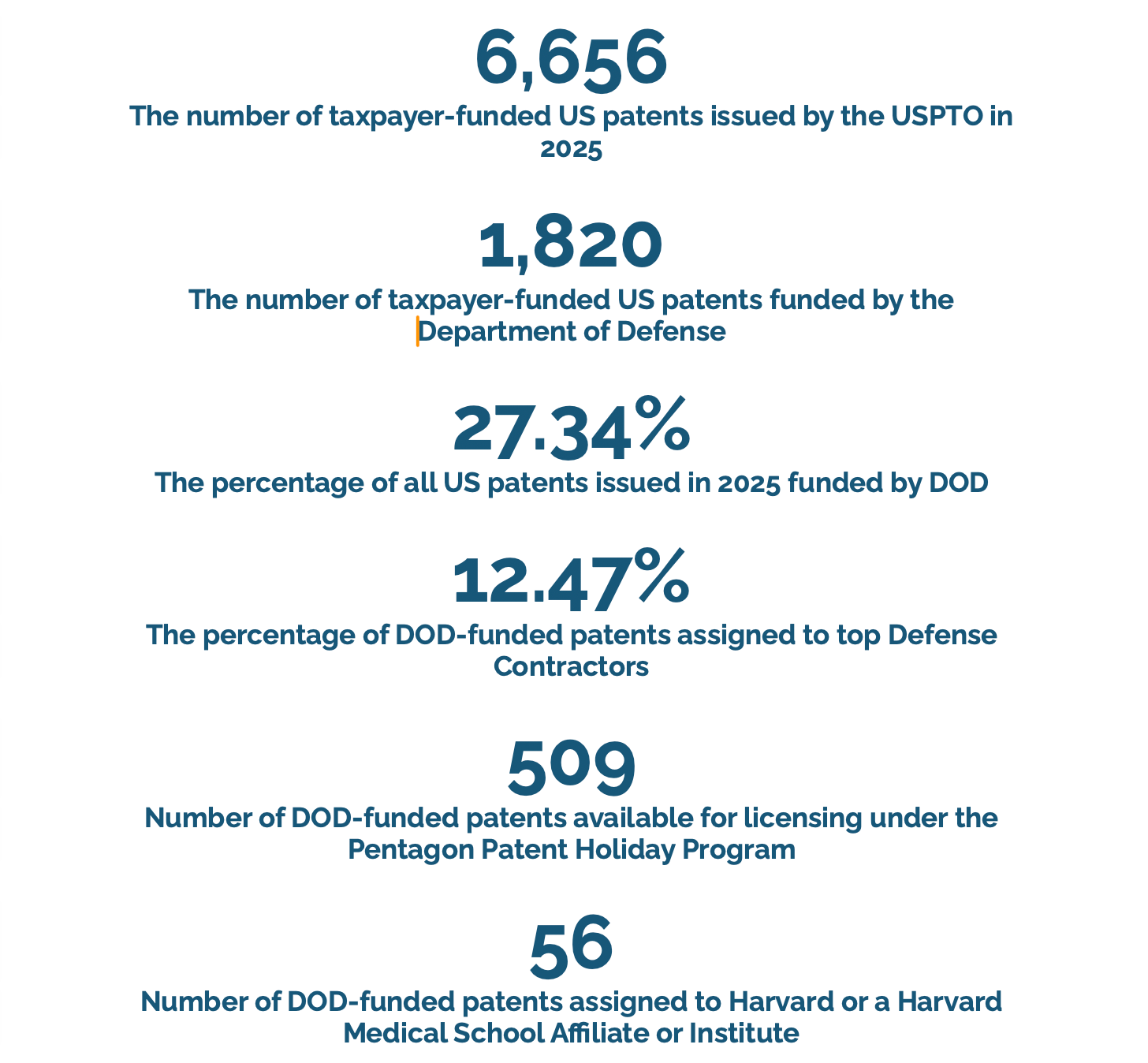
For those of you keeping track, DOD funded 1,820 patents in 2025. HHS funded 2,630, bringing the total to 4,450 patents. DOD and HHS accounted for 67% of the taxpayer-funded patents granted in 2025.
Who Received the Patents
Here are the entities that received Department of Defense-funded patents.
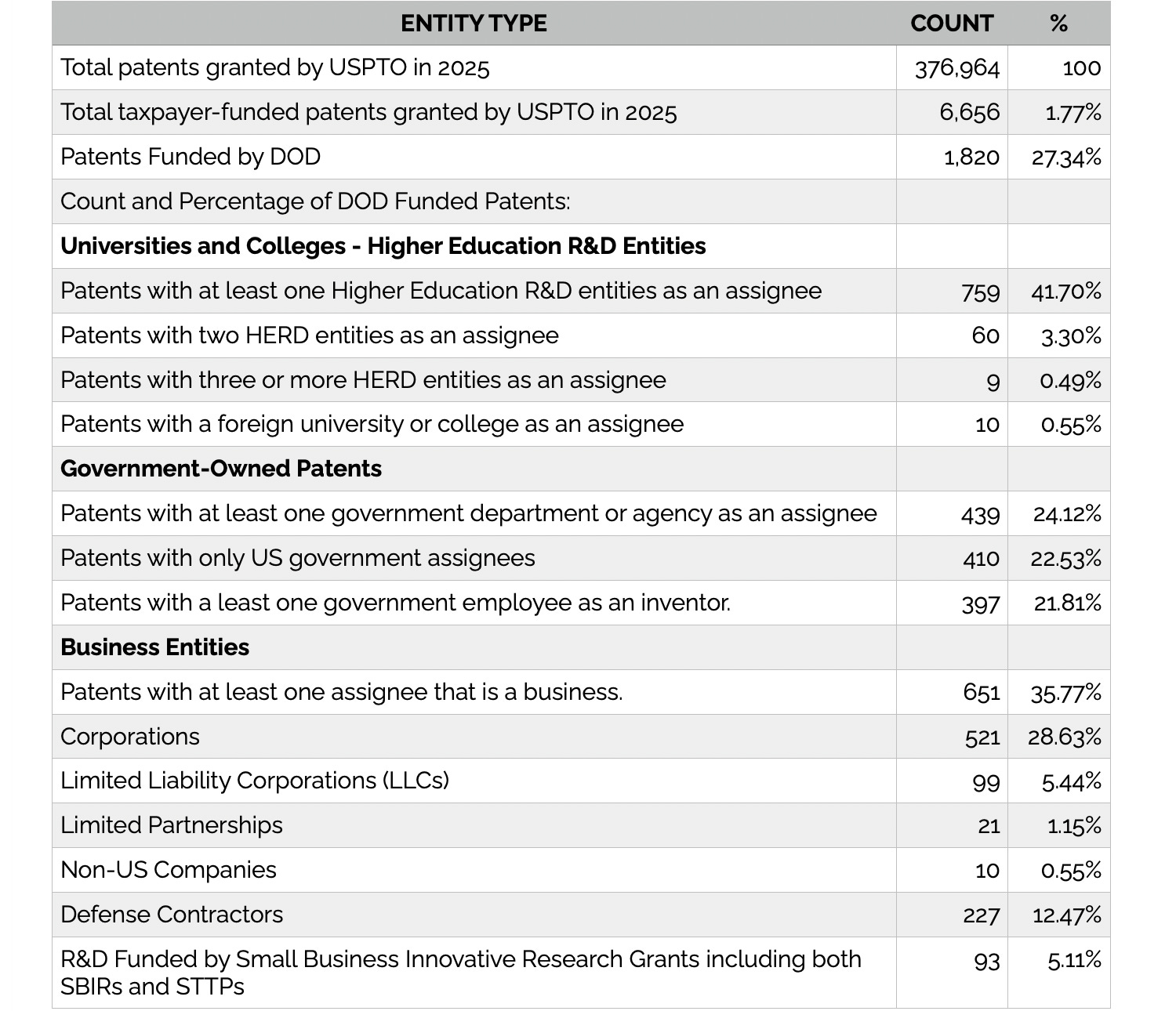
Patents awarded to small businesses that received funding from DOD is a small slice of the 2025 portfolio. DOD is actively seeking to engage with innovative small businesses. Check out the list of companies that were invited to participate in the Drone Dominance Gauntlet. While they aren’t always easy to dig out, we were surprised that so few of the companies receiving DOD-funded patents were participants in the Small Business Innovative Research Program.
The ten DOD-funded patents with foreign universities as assignees include:
Four patents with Canadian universities as assignees
Three patents with universities from Great Britain as assignees
Two patents with an Israeli university as an assignee
One patent with an Australian university as an assignee
Ten DOD-funded patents cite inventors from China, including:
Four patents for medical inventions, one funded by DARPA and three funded by the US Army Medical Research & Development Command
Three patents for Chemical and Material Engineering inventions were funded by the Air Force Office of Scientific Research (2) and the Office of Naval Research
Two patents funded by the Air Force Office of Scientific Research for Semiconductors, Electrical and Optical Systems, and Component Art
The most notable patent with a Chinese inventor is for a MULTI-COMPARTMENT MORTAR INCREMENT CONTAINER, US patent 12276488. This patent was the result of work by engineers at the U.S. Army Armament Research, Development and Engineering Center (ARDEC) at Picatinny Arsenal in New Jersey.
Who Funded The R&D
Here is a sample of the DOD funders whose research resulted in patents in 2025:
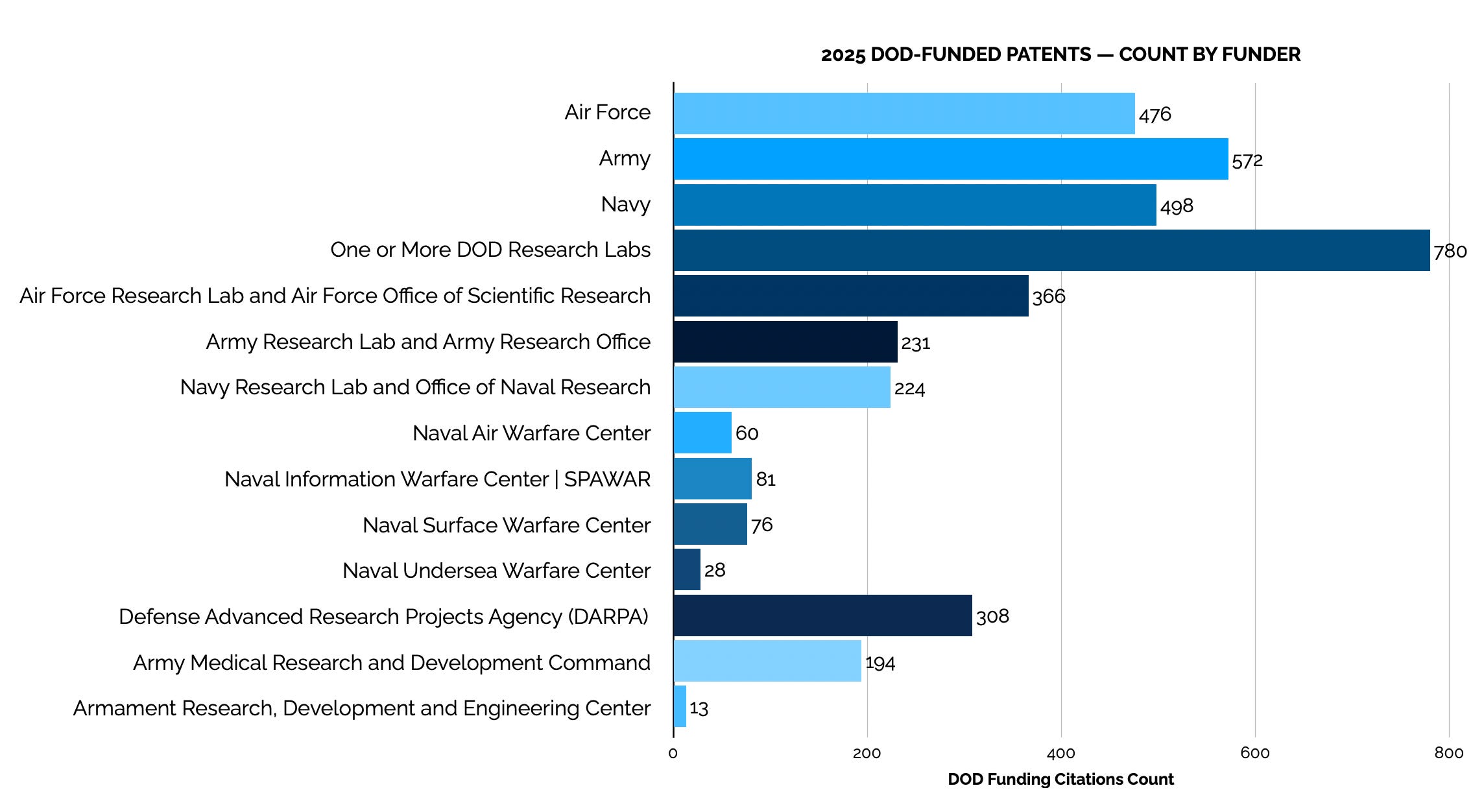
Here is what we found.
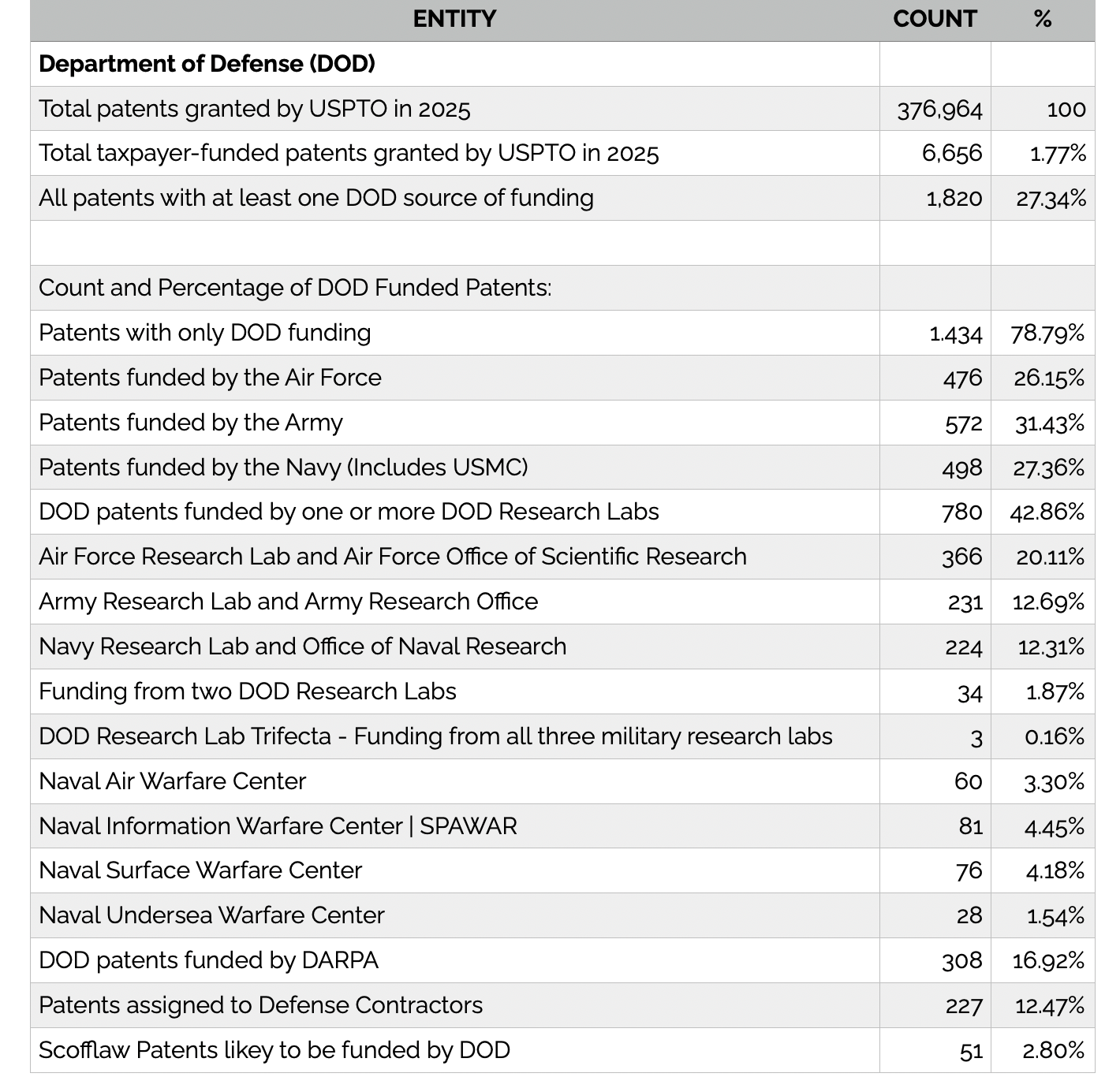
The 308 DARPA-funded patents don’t appear with DARPA contract numbers. A Military Interdepartmental Purchase Request (MIPR) enables dynamic funding of DOD programs. DOD MIPRs a lot of money around in its programs. They include all three DOD research labs as well as SPAWAR and others. Of the 308 patents that reflect DARPA funding, 179 have DARPA contract numbers.
38 patents were funded by the National Security Agency (NSA) in 2025. They include some obvious scofflaws who have patented a fine collection of high-performance computing inventions.
Defense Contractors and Scofflaws
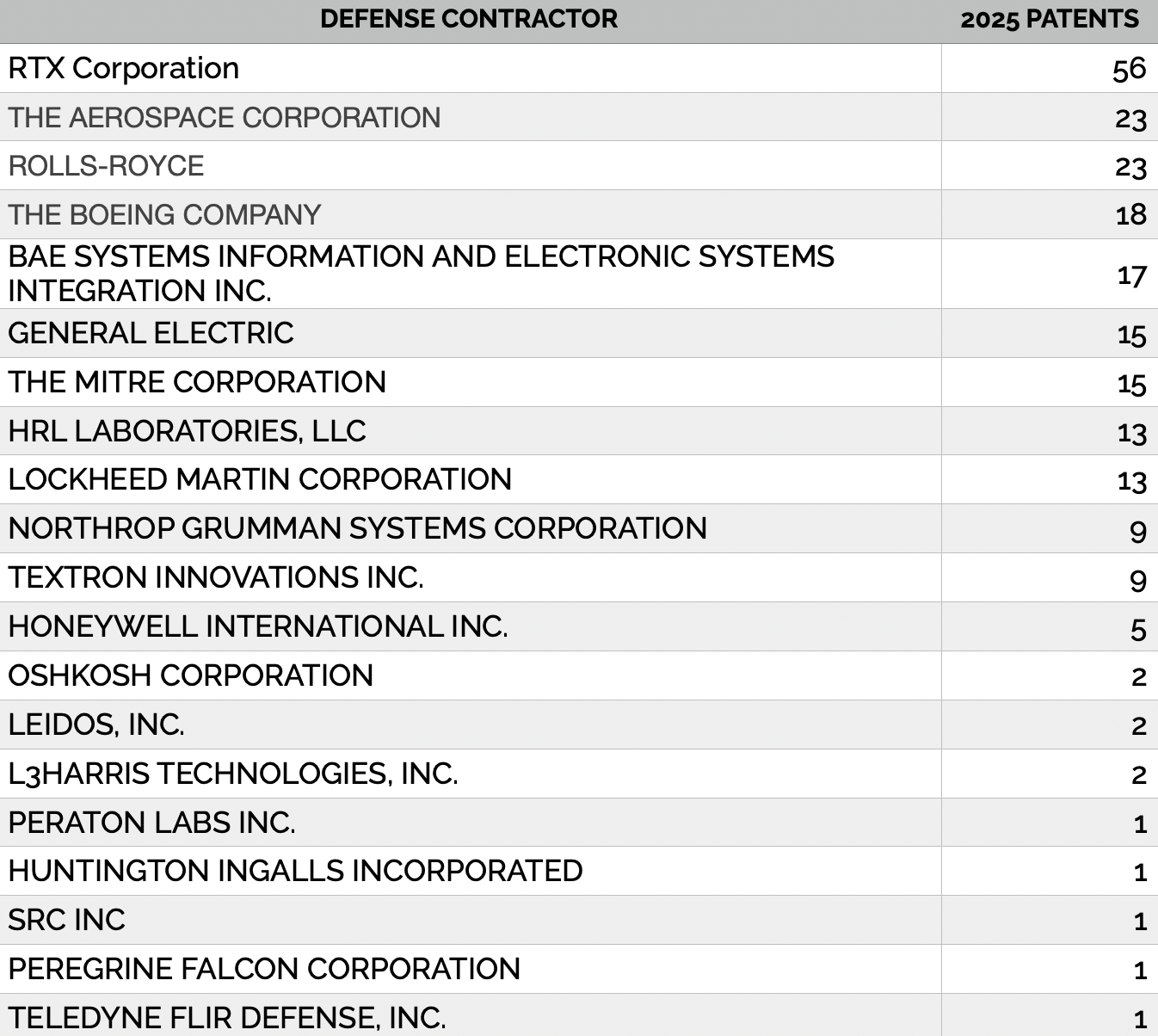
Determining what entities are defense contractors is fluid. Do you count every entity that received funding from DOD as a defense contractor? That doesn’t work. We took the easy way out and counted entities as defense contractors if they appeared on the 2025 Defense News Top 100 Defense Contractors list. We added firms that work exclusively for DOD.
In 2025, defense contractors received 227 patents for inventions created while working on government contracts and grants.
Hiding In Plain Sight Doesn’t Work
Which brings us to the DOD scofflaws. These are the contractors in the Defense community who seem to forget that they had a federal contract when they filed the patent application, or who adopt the new trend of entering a contract number fragment instead of the complete number. In 2025, there were 51 scofflaws that we linked to DOD contracts. almost 3% of all of the patents funded by DOD. And, the assignees included all of the top ten defense contractors. Chronic scofflaw RTX had the most scofflaw patents. Not putting a contract number on patents for gas turbine jet engines won’t hide the fact that these inventions were funded by DOD.
Dear Scofflaws, when the patent is for gas turbine engines, quantum computing, and superconducting materials, and there is no contract information or worse goofy language like that the government agency that supported it was a “classified agency”, the Chinese can figure out these are inventions for the defense community.
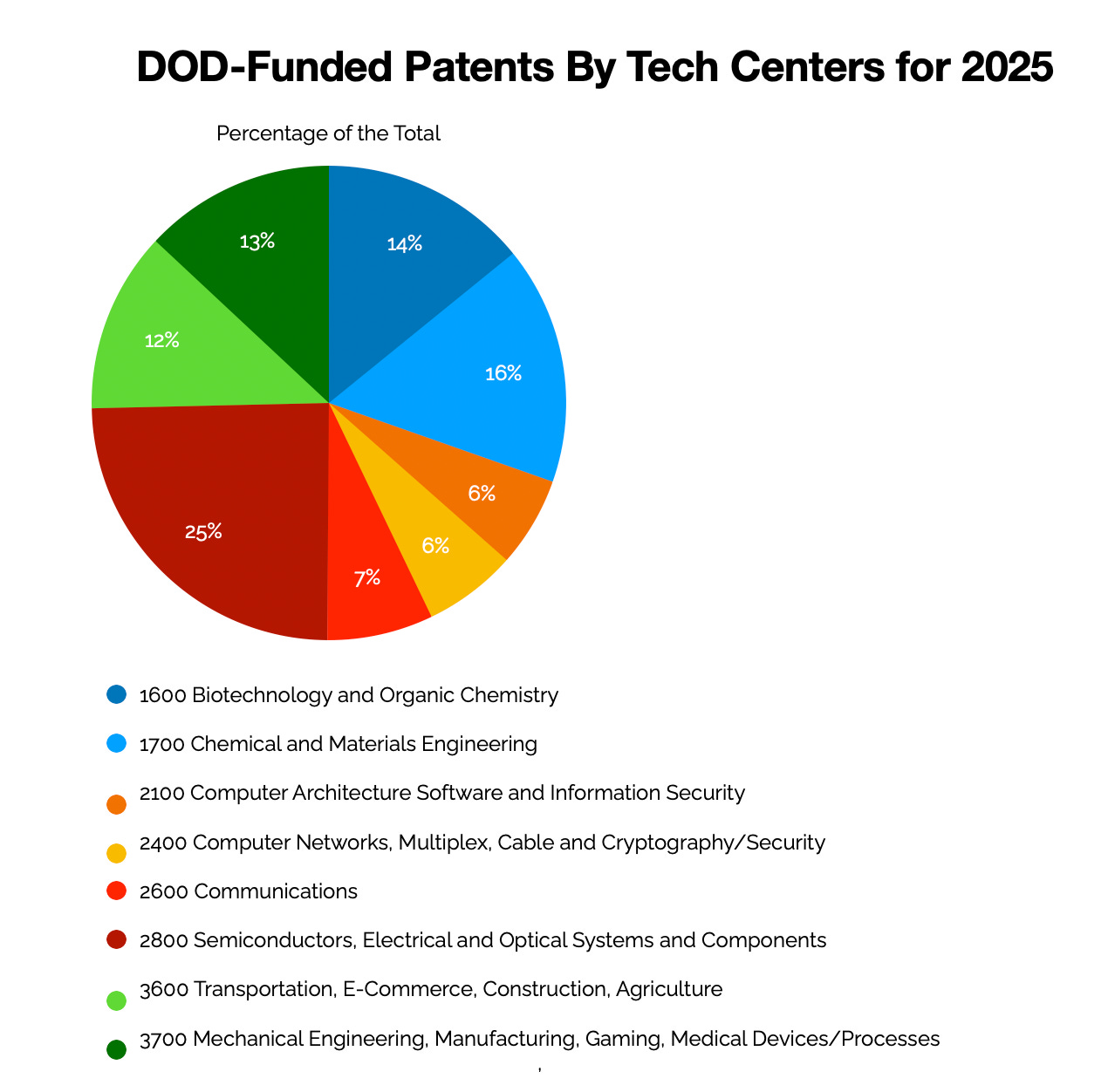
What the Inventors Invented
How Long Did It Take
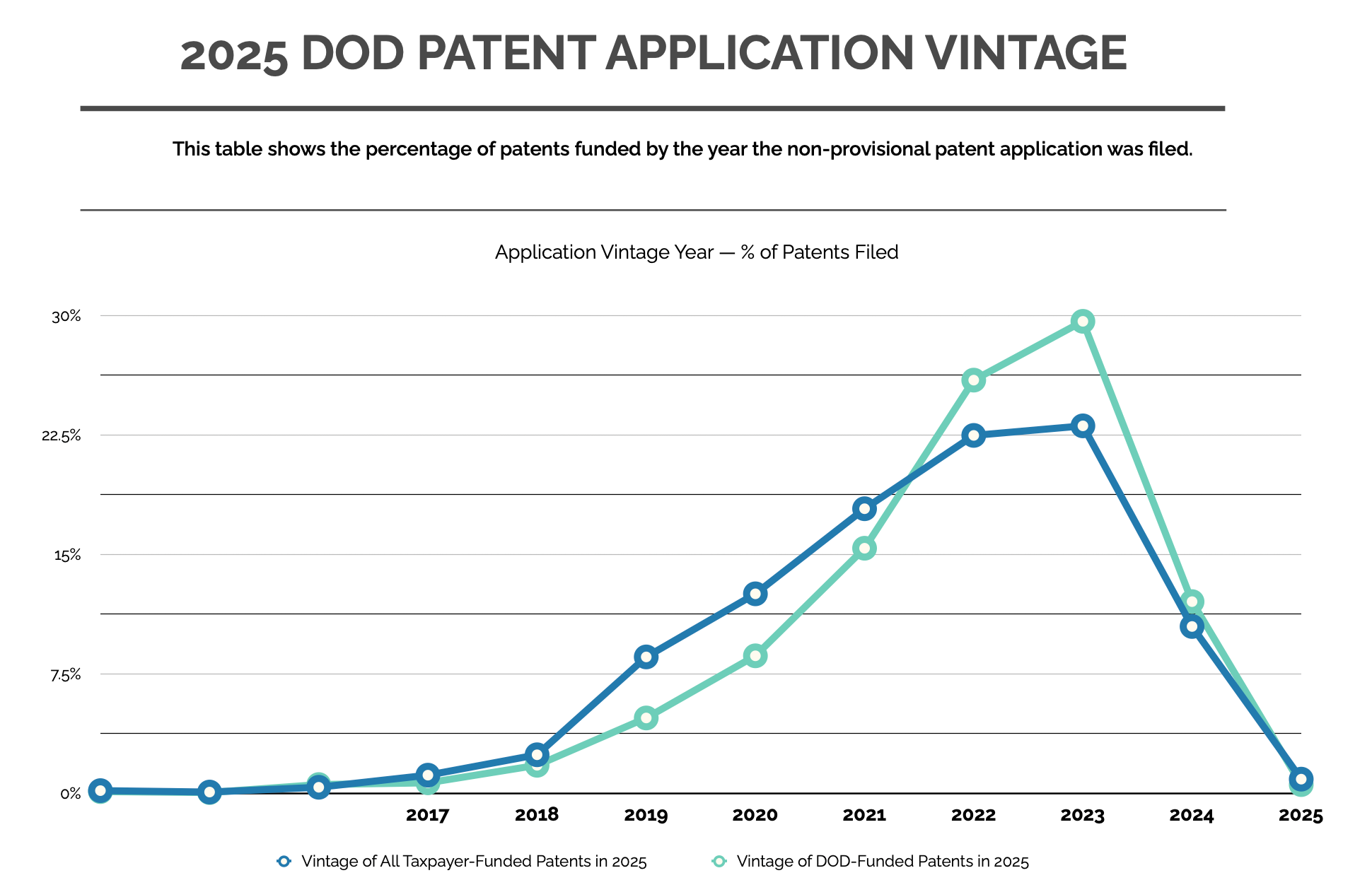
The chart below shows the vintage of the patent applications associated with DOD-funded patents granted in 2025. It compares the age of DOD patents with that of other 2025 patents. The non-provisional patent applications that become patents from DOD-funded inventors are a bit newer than other taxpayer-funded patents granted in 2025.
What’s Next
The Department of Defense identified its six critical technical priorities for the future. They are:
Applied Artificial Intelligence (AAI) — maintain decision superiority on the battlefield
Biomanufacturing (BIO) — harnessing engineered microorganisms to produce oils, lubricants, and coatings, this effort aims to eliminate supply chain vulnerabilities and reduce reliance on petrochemical processes that have migrated overseas
Contested Logistics Technologies (LOG) — Overcoming the challenges of disrupted or denied logistics to ensure seamless resupply and operational continuity in contested environments.
Quantum and Battlefield Information Dominance (Q-BID) - integrating quantum technologies with advanced radio-frequency systems to ensure secure, resilient communications, navigation, and sensing in contested, jammed, or denied environments.
Scaled Hypersonics (SHY) - accelerate the development and fielding of affordable hypersonic capabilities at scale
Scaled Directed Energy (SCADE) - High-Energy Laser and High-Power Microwave systems.
You can read more about the program and who is running the show here.
The Government Doesn’t Make Things
Taxpayer-funded patents are essential because the Government doesn’t make things. The way they get the things they need is either to contract with someone who builds them — jets, tanks, hypersonic missiles — or to acquire the technology they need by patenting it so companies that choose to commercialize the inventions have the IP needed to protect their investment and sell them to both the military and the private sector.
On the matter of logistics. Clearly, the challenges of disrupted and denied logistics are significant and need new technology and new strategies. A bigger challenge is expanding DOD’s supply base. In short, DOD needs more companies to buy things from. More suppliers mean more choices, which in turn means more competition, potentially leading to lower costs when spending taxpayer dollars.
About Harvard and Its Collaborators
If DOD wants to achieve its goals for its six critical technologies, it will need scientists and researchers at Harvard, as well as the broader academic scientific community. In 2025, Harvard received 56 patents resulting from grants and contracts funded by the DOD.
Harvard has been a major recipient of both contracts and patents from DARPA’s Biological Technologies Office (BTO). BTO leverages biological properties and processes to revolutionize our ability to protect the nation’s warfighters. In short, it is the home of DOD’s synthetic biology programs.
Harvard is also a major participant in the development of both quantum computing and artificial intelligence. Harvard and its collaborators hold important quantum computing patents and were the recipients of grants and patents under DARPA’s Quantum-Assisted Sensing and Readout (QuASAR) program.
DOD needs Harvard R&D regardless of what it thinks about its military fellowship program.
What We’re Working On
As always, thank you for reading FedInvent. Our next two newsletters will focus on the National Science Foundation 2025 analysis and on some thoughts on TechLink and DOD’s efforts to get more of the patented inventions it owns into the marketplace as dual-use technology.
Please let us know at info@wayfinder.digital if you have any questions or topics you’d like us to explore. See you next week.
The Team At FedInvent
FedInvent tells the stories of inventors, investigators, and innovators. Wayfinder Digital’s FedInvent Project follows the federal innovation ecosystem, taxpayer-funded research, and the inventions it supports. Please reach out if you have questions or suggestions. You can reach us at info@wayfinder.digital.